America’s Animal Shelter System Is Quietly Retreating From Public Service
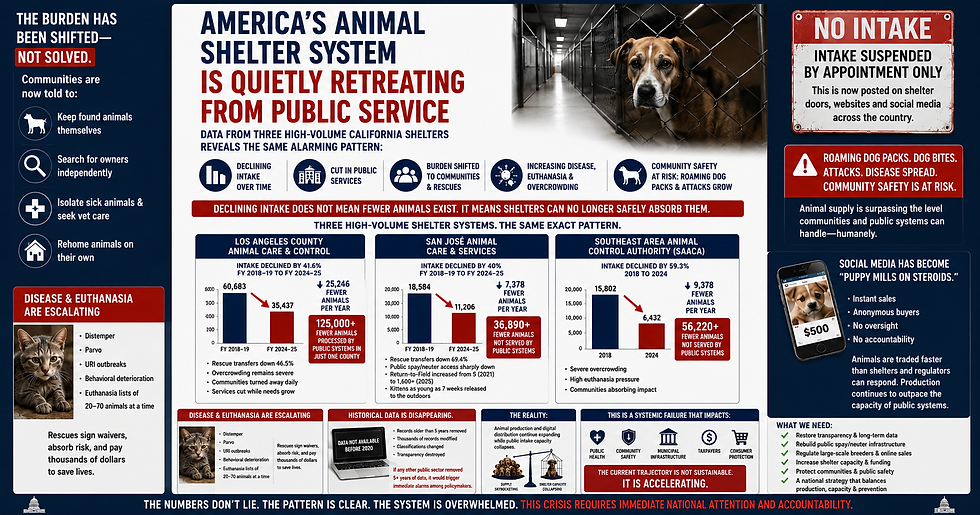
Animal Rescuers for Change (ARFC) reviewed trends from three historically high-intake California municipal shelter systems:
Los Angeles County Animal Care & Control,
San Jose Animal Care & Services,
and Southeast Area Animal Control Authority (SEAACA).
Across all three systems, the same pattern emerged:
Significant reductions in animal intake over time
Simultaneous overcrowding and operational crisis
Reduced public-facing services and intake accessibility
Growing transfer of burden onto communities and rescues
Expansion of Return-to-Field and unmanaged outdoor animal populations
Increasing disease exposure and euthanasia pressures
Loss of long-term historical public data visibility
The data does not support the conclusion that animal overpopulation has been solved.
The data supports a different conclusion:
Public animal service infrastructure is retreating while animal production and community burden continue expanding.
Please read the full report: When Shelters Stop Taking Animals: The Crisis Behind the Numbers
Declining Intake Is Being Misrepresented as “Progress”
National shelter dashboards and public narratives increasingly frame declining intake numbers as evidence of improvement.
However, this interpretation fails to account for the operational reality now visible across high-volume municipal systems.
In multiple jurisdictions, shelters openly publish:
“No Intake,”
“Appointment Only Intake,”
“Intake Suspension,”
or finder-hold instructions
directly on shelter websites, social media pages, and physical facilities because they are unable to safely absorb incoming animal volume.
This is not evidence that fewer animals exist.
It is evidence that systems can no longer physically process the same volume of animals they once accepted.
That distinction is critically important for policymakers.
Three High-Volume Systems Show the Same Exact Pattern
ARFC reviewed publicly available data from three historically high-volume California shelter systems.
The same operational pattern appeared in every system reviewed.
Los Angeles County Animal Care & Control
Los Angeles County intake declined from approximately:
60,683 animals in FY 2018–19to:
35,437 animals in FY 2024–25
This represents a reduction of approximately:
25,246 fewer animals annually,
or approximately 41.6% decline in intake capacity.
The sustained reduction in intake over a five-year period resulted in a cumulative decrease in publicly processed animals exceeding:
125,000 animals
within a single county system alone.
At the same time:
Shelter overcrowding remains severe,
euthanasia lists continued growing,
and communities increasingly reported being turned away or asked to manage animals independently.
This does not indicate resolution of overpopulation.
It indicates public service contraction under overwhelming volume pressure.
San Jose Animal Care & Services
San Jose intake reportedly declined from:
18,584 animals in FY 2018–19to:
11,206 animals in FY 2024–25
This represents approximately:
7,378 fewer animals annually,
or nearly 40% decline in intake.
At the same time:
rescue transfers collapsed by approximately 69%,
public spay/neuter access sharply declined,
and Return-to-Field (RTF) practices expanded dramatically.
Southeast Area Animal Control Authority (SEAACA)
SEAACA intake declined approximately:
59.3% between 2018 and 2024,
from approximately 15,802 animals to 6,432 annually.
Again, the same pattern appears:reduced intake, reduced absorption capacity, and increasing externalization of burden onto communities and rescues.
The Crisis Has Been Shifted Into Communities
For decades, municipal animal shelters functioned as essential public infrastructure. Their role extended far beyond simply housing stray animals. Shelters helped stabilize animal populations, reduce disease transmission, protect public safety, support sterilization efforts, and provide communities with a centralized system for managing abandonment, roaming animals, and emergency situations.
Increasingly, however, many communities are experiencing a quiet but significant shift in responsibility.
Instead of shelters serving as accessible intake systems, residents are now often instructed to keep found animals themselves, search independently for owners, isolate sick animals, arrange veterinary care at their own expense, or attempt to privately rehome animals through social media and informal networks.
The burden itself has not disappeared. It has simply been shifted outward — from public systems onto individual residents, rescues, and communities already struggling to cope.
As shelter intake capacity contracts, communities are increasingly absorbing the consequences directly:
unaltered animals continuing to reproduce,
growing stray populations,
roaming dog packs,
attacks on pets and livestock,
dog bite incidents,
disease exposure,
and mounting pressure on rescues and fosters operating without public funding.
At the same time, the infrastructure needed to manage these problems has not expanded alongside the growing demand.
This is no longer solely an animal welfare issue.
It increasingly affects public health systems, municipal liability exposure, neighborhood safety, and the overall stability of community infrastructure.
Social Media Has Become “Puppy Mills on Steroids”
At the same time shelters are reducing intake capacity, digital platforms have dramatically expanded the speed and scale of animal distribution. Animals are now sold instantly across jurisdictions through: social media, classified platforms, messaging apps, and anonymous online accounts with minimal traceability, verification, or oversight. From a population-management perspective, social media has effectively become: “puppy mills on steroids.” Digital platforms now amplify: impulse acquisition, rapid resale, anonymous breeding, and uncontrolled distribution at a scale local enforcement systems were never designed to manage. Meanwhile, local animal control agencies remain: understaffed, underfunded, technologically limited, and already overwhelmed with physical animal management on the ground. The result is structural imbalance: animal production and digital distribution continue expanding while public absorption infrastructure contracts.
At the very moment many shelters are reducing intake capacity and limiting public access to services, digital platforms have dramatically accelerated the speed, scale, and reach of animal distribution.
Animals can now be advertised and transferred across cities, counties, and state lines almost instantly through:
social media platforms,
classified advertising websites,
messaging applications,
breeder marketplaces,
and anonymous online accounts.
In many cases, these transactions occur with minimal identity verification, limited traceability, little oversight, and virtually no meaningful accountability.
From a population-management perspective, social media has effectively become what many rescuers describe as: “puppy mills on steroids.”
Unlike traditional breeder advertising, digital systems allow animals to be marketed continuously to massive audiences through algorithms, hashtags, targeted advertising, and rapid reposting. The result is an environment that amplifies:
impulse acquisition,
rapid resale and rehoming,
anonymous breeding operations,
and uncontrolled animal distribution at a scale local enforcement systems were never designed to manage.
Meanwhile, the public systems expected to absorb the consequences remain severely strained.
Local animal control agencies and shelters are often:
understaffed,
underfunded,
technologically outdated,
and already overwhelmed with physical animal management responsibilities on the ground.
As shelters struggle with overcrowding, disease exposure, staffing shortages, and declining intake capacity, digital animal distribution systems continue expanding almost without friction.
The result is a growing structural imbalance: animal production and digital distribution continue accelerating, while the public infrastructure responsible for absorbing and managing the consequences steadily contracts.
This imbalance increasingly pushes the burden onto:
communities,
rescues,
fosters,
local governments,
and taxpayers, while the overall volume of animals entering circulation continues to outpace the system’s capacity to safely and humanely manage them.
Disease Exposure and Euthanasia Volume Are Escalating
As frontline rescuers, ARFC member groups now routinely receive shelters euthanasia lists containing:
dozens,
and sometimes up to 70 animals at a time.
After being rescued from shelters, many animals arrive with warnings such as:
“distemper exposure,”
“parvo exposure,”
“URI outbreak,”
or behavioral deterioration caused by prolonged confinement and overcrowding.
Rescues are routinely asked to sign disease exposure waivers while assuming:
quarantine,
medical stabilization,
behavioral rehabilitation,
and veterinary expenses reaching thousands of dollars per animal.
Five years ago, many rescuers did not routinely encounter:
this scale of contagious disease,
this frequency of severe deterioration,
or euthanasia lists of this magnitude.
These are indicators of systemic destabilization.
Historical Public Data Is Quietly Disappearing
One of the most alarming findings identified during ARFC review was the removal or loss of long-term public historical shelter data. Refer to the Report: LA County, San Jose AC and SCAACA Data Analysis, Performance trends, ARFC.
Many public shelter dashboards now display only approximately five years of records, significantly limiting public ability to compare current operations against pre-COVID baselines.
In multiple systems:
older intake data disappeared,
records were modified,
classifications changed,
foster outcomes shifted,
and historical visibility became increasingly fragmented.
This would raise serious alarm in virtually any other publicly funded sector.
If:
hospital systems,
public health departments,
school systems,
law enforcement agencies,
or transportation agencies
suddenly removed long-term historical operational data while simultaneously reporting major service reductions, policymakers would immediately recognize the implications for transparency and accountability.
Public animal shelter systems should not operate under lower transparency standards than other taxpayer-funded public infrastructure.
Long-term historical visibility is essential for:
policy evaluation,
trend analysis,
fiscal accountability,
and honest public understanding of system performance.
This Is No Longer Sustainable
The current trajectory is not sustainable — not for shelters, not for rescues, not for communities, and not for taxpayers.
What is unfolding across many parts of the United States is not a temporary fluctuation or isolated operational challenge. It reflects a growing structural imbalance involving:
uncontrolled animal production,
declining public prevention infrastructure,
overwhelmed shelter systems,
shrinking intake capacity,
escalating disease pressure,
increasing public safety concerns,
and the steady transfer of responsibility from public systems onto individual communities and private rescue networks.
For decades, animal control systems depended on a basic balance between prevention, intake capacity, enforcement, adoption, and population management. Increasingly, that balance is breaking down.
At the same time public shelter systems are reducing intake and limiting services, uncontrolled breeding and digital animal distribution continue expanding through online marketplaces and social media platforms operating with minimal oversight. Meanwhile, public access to low-cost spay/neuter programs has sharply declined in many regions, further weakening long-term prevention efforts.
The result is a compounding cycle: more animals entering circulation, while fewer animals can be safely absorbed by existing public infrastructure.
Wise public policy requires balancing:
animal production,
shelter capacity,
public safety,
disease control,
prevention infrastructure,
and consumer transparency.
At present, those systems are no longer functioning in equilibrium.
The available data increasingly suggests the United States is entering a phase where the volume of animals entering communities is surpassing the level that shelters, rescues, and local systems can safely and humanely manage.
The consequences extend far beyond traditional animal welfare concerns. They increasingly affect:
public health systems,
municipal liability,
neighborhood safety,
disease management,
consumer protection,
and local government infrastructure.
Addressing this trajectory will require coordinated national attention involving:
legislators,
animal welfare agencies,
public health authorities,
consumer protection agencies,
and broader discussions regarding digital platform accountability and online animal sales systems.
Because the current trajectory is not stabilizing.
It is accelerating.


Comments