San Jose’s Expanding Return-to-Field Policy Is Putting Vulnerable Cats at Risk
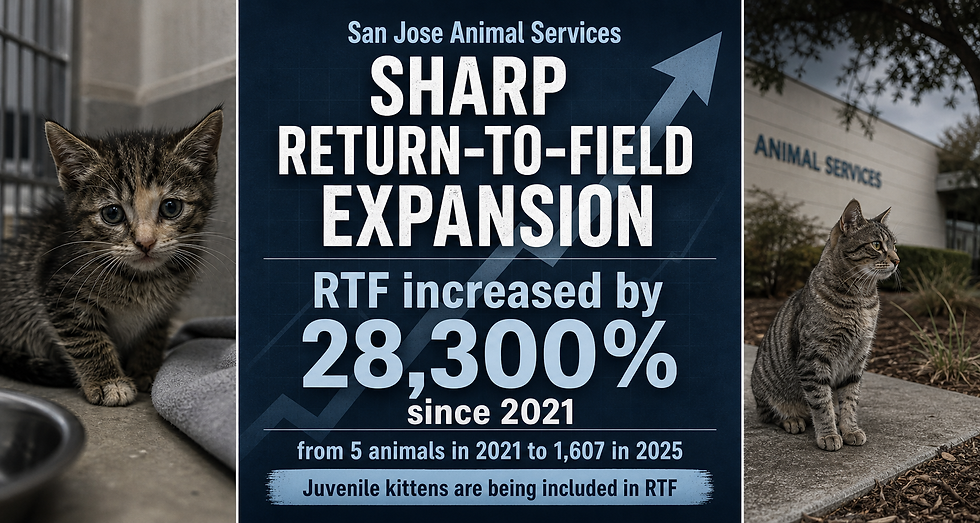
San Jose’s Return-to-Field program is no longer just a narrow tool for healthy adult community cats. It is rapidly expanding — and vulnerable animals are paying the price.
Recent data analysis shows that Return-to-Field (RTF) increased by 28,300% since 2021, rising from just 5 animals in 2021 to 1,607 in 2025. These were not simply cats briefly encountered and released. Many were held in shelter custody for days or even weeks before being returned outdoors.
The Return-to-Field (RTF) concept is a relatively recent shelter-based approach, introduced as an operational alternative to traditional Trap–Neuter–Return (TNR) programs. While TNR typically involves managed colonies with designated caretakers who monitor the animals’ well-being over time, RTF often lacks comparable post-release oversight.
In practice, RTF can function as a system-level outcome that removes animals from the shelter without ensuring ongoing care or monitoring after release. It is also counted as a “live outcome” in shelter metrics, contributing to higher Live Release Rates (LRR). However, this does not reflect actual welfare outcomes where friendly animals face significant risks after being returned to the environment.
There are also concerns that RTF may disproportionately impact friendly or adoptable animals, which in some cases are classified as “feral” and released rather than placed through adoption or rescue pathways—potentially improving reported statistics without improving real outcomes.
Source: Animal Population Dashboard. Data used in the analysis below was obtained in October 2024. Subsequent reviews of the same dashboard data indicate that dashboard data has been retroactively adjusted across multiple parameters, including intake and outcome figures. These dynamic changes, without preserved historical versions, limit the ability to verify past data and compromise long-term transparency and accountability.
Read Full Data Analysis: San Jose Deepening Animal Welfare Crisis, ARFC Report, 2026


That distinction matters.
RTF is generally meant for healthy, unowned, adult free-roaming cats. It was never intended to become a broad population-management tool for underage kittens, sick cats, medically fragile cats, or friendly cats who could safely live as pets. But the records reviewed suggest that is exactly what is happening.
A Program Expanding Without Clear Guardrails
San Jose Animal Care Center’s growing use of RTF raises serious concerns about animal welfare, transparency, and accountability.
The sharp rise in RTF suggests the practice is being used less as a carefully limited welfare strategy and more as a way to move animals out of the shelter system. And when animals are returned to the field after spending time in shelter custody, the shelter is no longer simply “leaving nature alone” — it is making an active decision about that animal’s fate.
That is especially alarming when the animals being released are kittens.
Kittens Are Being Sent Back Outside Too Young to Survive
The most disturbing finding is the return of underage kittens, including kittens reportedly as young as 7 weeks old, multiple kittens under 2 months age
At that age, kittens are still extremely vulnerable. They may not be able to reliably find food, avoid predators, or survive exposure, traffic, disease, and injury. Releasing them after days or weeks in custody does not give them a better chance. It simply moves the suffering out of public view.
Very young kittens should be receiving protection, foster placement, rescue transfer, or another safe pathway — not being sent back to fend for themselves outdoors.
Wildlife Gets More Protection Than Domestic Kittens
The contrast is hard to ignore.
Juvenile wildlife — such as raccoons — are typically released only when they are physically and behaviorally ready to survive on their own. Wildlife rehabilitation follows clear state and federal permit standards, and release age is based on actual survival ability, not convenience.
Typical wildlife release may happen at 4–6 months or older.
Yet in California, domestic kittens younger than 4 months old — some reportedly as young as 7 weeks — are being returned to the field with fewer protections than wildlife.
That should be a wake-up call.
Sick and Friendly Cats Are Also Being Returned in environment
The concerns do not stop with age.
The report also identifies cats released with medical designations, including moderate or severe medical conditions. In some cases, cats recorded as healthy at intake were later released as medical after spending time in shelter custody. That raises urgent questions about medical care, release decisions, and whether vulnerable animals are being protected before being sent back outside.
Volunteers also report that friendly, social cats — cats who could potentially thrive as pets — are increasingly being returned to the field instead of being placed for adoption or transferred to rescue.
That is not a humane outcome. It is a missed opportunity.
Misclassification of Animals
The report documents cases where: Friendly, socialized cats were classified as “feral”
Animals were held for months in adoption areas, then reclassified and released
Example:
A friendly cat (“Sam”) was misclassified as feral and returned to the field despite medical needs and clear dependence on human care. The animal later required urgent intervention, shifting the burden to the community.

Other cases show:
Cats promoted for adoption later released outdoors
Inconsistent classification and decision-making

After a prolonged stay in the shelter, Portia—a friendly, social cat—was simply released outside the shelter doors. She repeatedly tried to get back inside, shocking volunteers who witnessed it. Thankfully, a rescue group stepped in, saved her, and she was later adopted into a safe home.
Systemic Impact: Shifting Risk to the Community
Rather than resolving overpopulation, current practices may:
Shift mortality outside the shelter system
Increase the number of vulnerable animals in the community
Transfer responsibility to residents, rescuers, and volunteers
Young and medically fragile animals face:
Starvation
Disease
Injury
Exposure
—often without any survival pathway.
Who Is Responsible After Release?
Another major concern is the lack of clarity around where these cats are being released — and whether there is actually a caretaker in place to feed and monitor them.
Return-to-Field is often defended on the assumption that cats are being returned to a known location where someone is providing food, water, and basic oversight. But if records do not clearly show a verified caretaker, feeding plan, release address, or follow-up process, then the public is being asked to simply trust that these cats are safe.
That is not enough.
For very young kittens, sick cats, or cats held in shelter custody for days or weeks, this question becomes even more serious. Were they released to a managed colony? Was there a confirmed feeder? Was anyone responsible for noticing if the cat declined, disappeared, became injured, or needed help?
Without clear documentation, “Return-to-Field” can become a vague label for releasing vulnerable animals outdoors with no proof that anyone is actually caring for them.
And here is the hard truth: a release location is not the same as a caretaker. A field is not a safety plan.
Core Concern
Return-to-Field is being used beyond its intended scope.
Instead of serving as a targeted humane strategy, it appears to be applied broadly:
Without clear age thresholds
Without health safeguards
Without consistent classification
This raises concerns that RTF is becoming a population management shortcut, rather than a welfare-based decision.
If an animal cannot reasonably survive and remain safe after release, RTF is not an appropriate outcome.
Clear Standards Are Needed Now
San Jose needs clear, enforceable standards for Return-to-Field, including:
Minimum age thresholds
Restrictions on releasing sick or medically fragile cats
Protections for friendly and adoptable cats
Transparent public data
Documented release locations and outcomes
Stronger rescue and foster pathways
Real investment in low-cost spay/neuter services
If RTF is going to continue, it must be governed by clear rules that protect animal welfare, public trust, and legal accountability.
Because very young kittens, sick cats, and friendly cats deserve more than being pushed back outside.
They deserve care.They deserve safety.They deserve a real chance.
RTF does not erase shelter responsibility. A cat in custody is not just a statistic to be moved into a live-outcome category. Before release, the shelter must be able to show that returning the animal outdoors was medically, behaviorally, and welfare-appropriate.
We encourage you to read the full ARFC report below.
Download full Document:
Take action: Contact your city officials and SJACS management.
Ask for data transparency.
Demand clear standards and accountability.
Mayor Mayor Matt Mahan mayor@sanjoseca.gov 408-535-4800
District 1 Councilmember Rosemary Kamei district1@sanjoseca.gov 408-535-4901
District 2 Councilmember Pamela Campos district2@sanjoseca.gov 408-535-4902
District 3 Councilmember Anthony Tordillos district3@sanjoseca.gov 408-535-4903
District 4 Councilmember David Cohen district4@sanjoseca.gov 408-535-4904
District 5 Councilmember Peter Ortiz district5@sanjoseca.gov 408-535-4905
District 6 Councilmember Michael Mulcahy district6@sanjoseca.gov 408-535-4906
District 7 Councilmember Bien Doan district7@sanjoseca.gov 408-535-4907
District 8 Councilmember Domingo Candelas district8@sanjoseca.gov 408-535-4908
District 9 Vice Mayor Pam Foley district9@sanjoseca.gov 408-535-4909
District 10 Councilmember George Casey district10@sanjoseca.gov 408-535-4910
City Manager Jennifer Maguire Jennifer.Maguire@sanjoseca.gov
Deputy City Manager Angel Rios angel.rios@sanjoseca.gov
Parks, Rec, Neighborhood Services Jon Cicirelli jon.cicirelli@sanjoseca.gov
Deputy Director, Animal Care and Services Monica Wylie monica.wylie@sanjoseca.gov


Comments