Accountability Must Work in Every Direction: California Needs an Animal Welfare System, Not Another Scapegoat
Updated: Aug 31

California Wants More Animal-Welfare Accountability. First, It Needs Reliable Data.
For nearly two years, Animal Rescuers For Change (ARFC), a coalition representing more than 100 California rescue organizations, has advocated for one coherent statewide animal welfare system.
Long before the Miranda tragedy brought renewed attention to rescue oversight, we were raising structural problems with legislators, stakeholders, the California Department of Justice (regarding the agency criteria unevenly applied and interpreted by various shelters), the California Department of Public Health (regarding a complete roster of publicly funded, or with public contracts shelters), and the media.
Our message has been consistent: California needs prevention, reliable statewide data, animal traceability, spay-neuter capacity, breeder accountability, transparent registries, uniform standards, fair rescue access, and accountability across the entire system—not just one part of it.
California Still Doesn't Have a Complete Picture of Its Own Animal Welfare System
According to Cause IQ data derived from publicly available IRS records that we reviewed, California has approximately 3,700 registered animal-rescue nonprofits: California’s Rescue Community by the Numbers: Thousands of Organizations, Most of Them Small. Yet California does not appear to maintain a definitive, current statewide roster of its publicly operated and government-contracted animal shelters.
ARFC reviewed the major available third-party data sources, including Shelter Animals Count, Best Friends Animal Society, and UC Davis reporting, and found varying organizational populations, reporting structures, and substantial gaps. Across these sources, less than half of California’s shelter population appears to be represented, with some major high-intake systems missing. Coverage of California’s nearly 3,700 rescue nonprofits is even more limited.
For example, among the 200+ government-operated or government-contracted shelter entities or systems we independently identified, only about 70—approximately 35%—reported any 2024 data to Shelter Animals Count, and only about 60—approximately 30%—provided a complete annual dataset.
These third-party platforms provide useful information, but none offers a comprehensive picture of California’s shelter and rescue system. Different datasets can contain different organizations, while major systems may be absent altogether—making statewide trends difficult to evaluate without knowing exactly who is and is not represented.
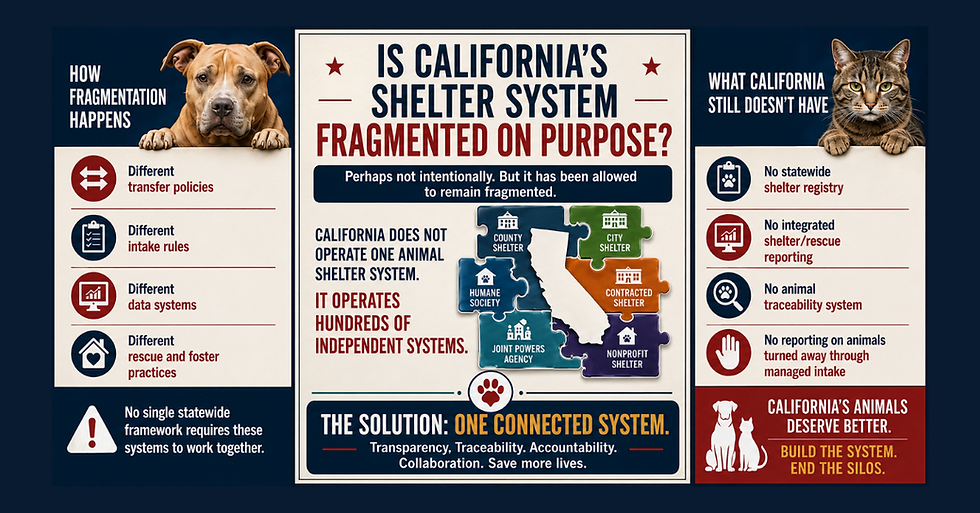
Please read our full publications for the underlying research, methodology, and detailed comparisons of Shelter Animals Count, Best Friends, UC Davis, historical state reporting, and California’s broader animal-data gaps: California’s Shelter Data gaps: Is California's Shelter System Fragmented by Design?
Our conclusion and message to legislators for 2 years was simple:
California does not currently provide a readily accessible, authoritative roster and comprehensive statewide dataset covering its animal sheltering and rescue system, their intakes, outcomes, and operational statistics. OVERRELIANCE on partial datasets from third parties - can not substitute for lack of factual performance data from multiple CA providers.
That matters enormously. If we cannot confidently establish the denominator, statewide percentages and trends keep being interpreted differently.

We Raised These Exact Problems During AB 631—in 2025 and Again in 2026
ARFC supported the objective of greater transparency behind AB 631. But throughout the discussions, we repeatedly raised structural concerns with legislators, stakeholders, and others involved in the proposal.
Our position was never that California needed less transparency. We were asking for a system that would actually produce reliable statewide information.
Concern 1: Publication Without Aggregation or Reconciliation Is Not a Statewide Data System
AB 631 relied heavily on individual shelters and rescues separately publishing intake and outcome statistics, but it did not establish the centralized statewide aggregation and animal-level reconciliation ARFC repeatedly requested.
That distinction matters.
A rescue could report: 500 dogs received. 500 dogs adopted.
But which 500 animals? Where did they originate? How many came from public shelters versus directly from communities? Could those animals be reconciled with shelter transfer records? Where did they ultimately go?
California shelters already assign individual animal IDs and maintain animal-level records for animals in their custody. What California lacks is the infrastructure connecting those records across the system.
Instead of requiring thousands of organizations to separately publish numbers and expecting the public to reconstruct the statewide picture, ARFC proposed standardized reporting through secure, authorized channels, centralized statewide aggregation, and meaningful reconciliation of shelter transfers and rescue outcomes.
During our 2025 discussions, we were told that “some volunteers” could potentially gather rescue statistics from websites and Facebook pages and enter them into a third-party system such as Shelter Animals Count.
From approximately 3,700 separate California rescue nonprofits?
Who verifies what was collected? Who ensures it was entered correctly? What happens when an organization has no website? Why should California's understanding of its animal population depend on unnamed volunteers manually searching thousands of websites and social-media pages?
Publication is not the same thing as a data system.
That is why centralized statewide aggregation and meaningful animal-level reconciliation were two of ARFC's principal proposed additions to the AB 631 framework. These key provisions were not included in the bill.
Concern 2: The Burden and Implementation Structure Were Inequitable and Unnecessarily Complicated
AB 631 also created an imbalance in how transparency obligations would affect very different organizations.
Taxpayer-funded shelters should publish comprehensive data. We believe transparency is part of their public responsibility and duty to taxpayers.
Yet publicly funded shelters without websites could receive an exception from online publication requirements—even though some shelters already demonstrate the administrative and technical capacity to compile and transmit intake, outcome, and transfer data to voluntary third-party aggregators.
That raised an obvious question:
If shelter data can already be compiled and transmitted to organizations such as Shelter Animals Count or Best Friends, why should providing comparable transparency to the California taxpayers funding those shelters be considered an unreasonable burden?
Meanwhile, many rescues have no employees, administrative departments, or websites. Some are literally one- or two-person volunteer organizations operating from foster homes.
Requiring thousands of small rescues to function as miniature reporting departments—or respond individually to repeated information requests—is not the most efficient way to create transparency.
ARFC proposed something simpler:
One secure reporting channel. Standardized submissions. Centralized aggregation. One reliable statewide dataset accessible to the public.
More transparency, with less duplication.
The fiscal discussion surrounding AB 631 reinforced this concern. Earlier Assembly analysis characterized shelter publication costs as relatively limited because much of the underlying information was already maintained. Later fiscal discussions moved toward unknown state costs, which can become a significant obstacle during the appropriations process.
Again, the question was straightforward:
Why create thousands of separate publication obligations when California could build one efficient statewide reporting infrastructure?
Concern 3: The System Still Failed to Account for Animals Shelters Refused or Redirected
Perhaps the largest remaining blind spot was outside the shelter doors altogether.
Across California, shelters increasingly use managed intake, appointments, diversion programs, and other restrictions on accepting animals. Rescues therefore receive animals not only through formal shelter transfers, but also directly from residents when public shelters decline or redirect intake.
Those animals may never receive a shelter animal ID and may never appear in conventional shelter statistics.
If a resident brings an animal to a public shelter, is turned away, and a rescue ultimately takes that animal instead, California still experienced an animal-welfare event. It simply happened outside the shelter's recorded intake.
Yet the resulting statistics can show fewer shelter intakes.
ARFC therefore raised the need to capture animals presented to shelters but not accepted, as well as rescue direct-community intakes, so California can understand where responsibility and costs are actually moving.
We discussed mechanisms through which rescue information could become part of a broader statewide animal-data structure rather than remaining invisible. We were told, in substance, that shelters did not want responsibility for collecting rescue information.
But somebody has to account for these animals.
California cannot increasingly shift public animal-service responsibilities toward residents and nonprofit rescues while simultaneously leaving those animals outside the state's statistical picture.
Without measuring animals that shelters refuse, redirect, or never formally intake, California risks measuring the workload shelters accepted rather than the actual level of animal need in their communities.
What We Were Asking AB 631 to Become
These were not arguments against transparency.
They were arguments for stronger transparency:
Centralized statewide reporting. Standardized data. Animal-level reconciliation. Shelter transfer traceability. Recognition of animals redirected into communities and rescues. Clear responsibility for implementation. And a system the public can actually use.
California does not need thousands of disconnected publication points and another law whose critical implementation details remain open to interpretation.
It needs one coherent statewide animal-welfare data system.
That is what ARFC was asking for during AB 631, and it remains one of the central reforms we are asking California to establish today.
We Have Tried to Put This Perspective Into the Public Record
ARFC regularly and respectfully communicated these concerns to AB 631 stakeholders and also had discussed them with CalAnimals in 2025, even where CalAnimals was not a direct bill sponsor, because of its important role representing California's sheltering community.
We have also provided this research and perspective to journalists and social-media advocates who continue describing AB 631 as a revolutionary transparency proposal.
Several journalists have spent considerable time speaking with us—often after contacting ARFC themselves. Some expressed substantial interest, and some told us that material had been submitted to editors, but no publications . Very little of this perspective has appeared in mainstream coverage.
We are therefore grateful to Ed Boks, who took the time to examine these issues and publish an analysis after hearing ARFC's perspective: How California Keeps Killing Animal Bills
ARFC was not formed to become popular within Sacramento lobbying circles—or any other institutional circle.
Our purpose is much simpler: bring factual information and front-line experience to decision-makers, respectful discussions with stakeholders and welfare participants so legislation is more accurate, equitable, and workable.
We wanted rescue data included safely and fairly in California's statewide picture—not scattered across thousands of websites and then reconstructed by third-party organizations working with incomplete datasets.
California taxpayers, legislators, journalists, shelters, rescues, and the public deserve information that is transparent, verifiable, and capable of showing the whole system.
And Now California Has an Opportunity to Get It Right
We are encouraged that California's fragmented animal-welfare infrastructure is finally receiving greater attention and that serious discussions are underway about creating centralized state oversight. Read one of our earlier Reports on the subject of the Animal Crisis: California Domestic Animal Crisis, Legislative Brief 2026
But there are still important questions requiring factual and balanced discussion.
Centralization should not simply mean creating a new authority capable of imposing additional penalties on rescues while leaving the fragmentation underneath intact.
It should mean fixing the fragmentation: one coherent statewide picture; reliable data; transparent organizational rosters; fair and uniform standards; meaningful animal traceability; recognition of community animals absorbed by rescues; and accountability that works in every direction.
That is what ARFC has been asking for all along. We extensively communicated these concerns with Assemblymember Lee’s office in both 2025 and 2026, as well as with multiple other legislators, including Assemblymember Rogers, Senator McGuire, and legislators representing Humboldt County.
When we learned there were efforts to bring AB 631 back from the Suspense File this summer, we made sure these offices were aware of the significant gaps we had identified and the solutions we had repeatedly proposed.
Most importantly, AB 631 proposed no clear, reliable mechanism for aggregating thousands of separate shelter and rescue publications into one authoritative statewide dataset. We repeatedly flagged this as a fundamental flaw. California does not need another vague law that leaves critical implementation questions open to interpretation: Who collects the data? Who reconciles it? Who verifies it? Where is it aggregated? And who is ultimately responsible for producing reliable statewide totals?
California already has experience with animal-welfare laws whose meaning and implementation remain disputed for years. The Hayden Act continues to generate disagreements over interpretation and litigation involving public shelters, with taxpayers ultimately bearing the costs when government agencies must defend those multiple disputes in court.
That history should teach us something: when California creates a major new animal-welfare mandate, the operational mechanism should be clearly written into the law—not left for shelters, rescues, advocates, agencies, and eventually courts to interpret afterward.
Our position was never that California needed less transparency. We were asking for stronger transparency infrastructure: one clearly defined reporting mechanism, centralized aggregation, standardized data, meaningful reconciliation, and clear responsibility for implementation.
Ultimately, AB 631 was not pulled from suspense and did not advance this summer.
Miranda Demonstrated Why Centralized Traceability Matters
The Miranda case is being used—understandably—to demonstrate why rescue oversight is needed.
But people should realize something important: there still will not necessarily be animal-level ID traceability, because California law does not explicitly require shelters to provide this type of statewide traceability. Even though, in our opinion, this should be part of their job description, the law does not currently establish such a system. So it remains optional and fragmented.
This is the regulatory Wild West we keep describing: the same rescue can be an approved lifesaving partner in one jurisdiction and effectively banned in another, depending on a completely different set of local rules and administrative requirements. We have flagged these barriers experienced by the rescue community to CalAnimals and to multiple reporters who spoke with us as well, and we provided reports that will be published later. So far, we have not seen any mainstream publications covering this perspective. Please let us know if you come across one.
But the Miranda case demonstrated something else too:
California's public system failed to readily track where large numbers of publicly sheltered animals went.
Jennifer Raymond had to spend months Google-searching for shelters jurisdiction by jurisdiction and pursue extensive public-records requests simply to reconstruct transfers. Some organizations did not respond. Some Humane Societies conveyed that they did not consider themselves subject to public-records requests.
Jennifer—or anybody else in the state—still does not have a complete list of California shelters, because a definitive statewide roster does not exist.
We contacted the California Department of Public Health (CDPH) ourselves in search of a statewide roster of California municipal shelters and organizations contracted to perform public sheltering services. To our surprise, CDPH did not have one either.
CDPH historically collected shelter-related rabies reporting, with some counties voluntarily providing intake information. But that information was aggregated by county, rather than maintained as a comprehensive organization-by-organization shelter roster. So even that historical system did not provide the statewide shelter registry we were looking for.
Why should a private citizen have to conduct this investigation?
If public shelters transferred hundreds or thousands of animals to an organization, those shelters controlled the original transfer records and had full governmental authority long before members of the public attempted to reconstruct the history.
So the fair question isn't only:
“How do we monitor rescues more aggressively?”
It is also: “Why did the publicly funded system transferring these animals fail to detect and respond to the pattern while already having legal authority?”
If there were repeated public complaints, what follow-up occurred? If unusually large numbers of animals were moving to one destination, what mechanism existed to flag that pattern?
If California could not easily reconstruct those movements afterward, why wasn’t statewide traceability already required? ARFC has been urging California legislators for the past two years to establish this very system, but so far, our requests have not resulted in legislative action.
Accountability cannot suddenly begin at the rescue's front door.
Public Shelters Must Be Part of the Accountability Conversation
There is an even larger issue receiving remarkably little attention.
Across California, publicly funded shelters have increasingly adopted managed intake, appointment-only systems, diversion programs, and restrictions on accepting animals.
When a shelter closes or narrows its doors, the animals do not disappear.
LA County alone has reduced its annual animal intake by approximately 25,000 animals per year over the past four years. But you would not readily see this trend by going to individual shelter websites. Why? Because much of the historical data has been removed. And neither Shelter Animals Count nor Best Friends provides the complete historical picture either. Please read our Report: When Shelters Stop Taking Animals: The Crisis Behind the Numbers
That brings us to another important component: data retention. Data older than four or five years that was previously published should not simply vanish from public shelter websites. This is public data, and the public should continue to be able to look it up.
The animals themselves move into communities. Finders keep them, when told ‘no space at shelter’. Families attempt to rehome them online. Volunteers network them. Rescues absorb them.
And then conventional shelter statistics can show fewer intakes. That creates a profound policy problem.
Would California consider a public school successful because it reduced enrollment by refusing students at the door?
If hospitals facing overwhelming demand simply stopped accepting patients, would government celebrate the resulting decline in admissions as successful capacity management?
Or would California recognize a capacity emergency and investigate why a taxpayer-funded essential service could no longer meet community demand?
Animal services deserve the same scrutiny.
If publicly funded shelters change their operating model and transfer responsibility to residents and nonprofit organizations, California must measure that displacement:
How many animals were presented? How many were accepted? How many were redirected? Where did they go? What costs were shifted to residents and rescues? What ultimately happened to those animals?
Otherwise, California risks measuring the workload shelters accepted rather than the actual need within the community.
And Then We Ask Why Rescues Become Overwhelmed
This question is almost entirely absent from the current narrative.
When authorities eventually encounter a rescue with 100, 200, or 300 animals, enforcement may absolutely be necessary if animal welfare has deteriorated.
But where did those animals come from? How many came from public shelters? How many were facing euthanasia?
How many came from residents who had already sought shelter assistance and not received it?
How many were animals the public system itself did not accept?
Did the rescue performing public service receive any help before reaching crisis capacity?
Was there a mechanism to provide temporary capacity relief?
Could animals be safely returned to the shelter system?
Was there actually somewhere else for those animals to go?
These questions do not excuse neglect. They help prevent it.
If California examines only the final collapse while ignoring the pathway that produced it, we will continue responding to emergencies rather than preventing them.
Rescues Are Already Regulated—Just Through a Fragmented Maze
California rescues are already regulated, and interact with the California Department of Justice, Franchise Tax Board, IRS, local animal-control agencies, zoning authorities, kennel regulations, and individual shelter-partnership systems.
ARFC contacted the California DOJ after observing, and hearing repeatedly from rescues, that some public shelters use DOJ charitable-registration status to determine rescue eligibility—blocking local rescues while they wait through a registration process that can be backlogged for months. At the same time, some of these same shelters publicly list out-of-state organizations as approved rescue partners, while not registered with CA DOJ and FTB at all.
This unequal access for local rescue groups highlights not only the inconsistency of the system, but a serious lifesaving consequence. Local rescues often have established foster, volunteer, veterinary, and transportation networks nearby and can react immediately when an animal is placed on a short-notice euthanasia list. Out-of-state organizations cannot always respond to an emergency within hours as efficiently as an established local network.
When administrative barriers prevent capable local rescues from pulling animals facing immediate euthanasia, California needs to ask whether those requirements are actually protecting animals—or unnecessarily limiting the very lifesaving capacity shelters urgently need.
But charitable registration concerns financial and fundraising compliance. It can take months to process. It does not establish whether an organization has competent fosters, veterinary relationships, responsible placement practices, or the capacity to care for a particular animal.
Meanwhile, a legitimate rescue approved by one shelter can cross a county line and essentially start over—another application, another document package, another set of rules, far too often declined to save euthanasia animal because of arbitrary rules, not grounded in any particular regulation, here is one example, that also was discussed by Ed Boks, after ARFC had provided examples: How LA County's Rescue Program Fails
Multiple rescues also encounter outdated local animal-number and kennel codes that make responsible expansion practically impossible. The problem, therefore, is not simply that California needs “more regulation.”
California needs coherent regulation that actually measures the right things. We have also conveyed these concerns to CalAnimals through respectful discussions, particularly as the organization leading efforts to establish a statewide Animal Welfare Bureau.
Consider another imbalance we have repeatedly raised: a rescue can be banned from saving animals on a euthanasia list because it was late providing spay-neuter certificates for animals it previously rescued—even when the rescue remains responsible for completing those surgeries. Spay-neuter appointments can be extremely difficult to obtain, and some animals first require medical rehabilitation or treatment for infections and are simply not yet medically ready for surgery. Read examples, that far too multiple CA rescues are currently experiencing: The Shelter That Turned Compliance Into a Weapon
At the same time, Craigslist and other public marketplaces remain filled with unaltered and unvaccinated animals, while animals can continue to be produced and sold with limited guardrails, accountability, or traceability of who breeds them.
Why should the rescue—the organization actually assuming responsibility for vaccination, veterinary care, spay-neuter, and placement—face barriers to saving another animal, while the largely uncontrolled production pipeline feeding animals into this crisis remains insufficiently addressed?
This is another policy issue ARFC has specifically flagged to CalAnimals, and asked for their support in establishing a coherent breeding accountability framework.
All of the underlying legislation matters for an upcoming Agency in whatever format this will be proposed. Increasing enforcement against one of the most accountable parts of the animal-welfare community while leaving a fragmented, inadequately regulated animal-production system largely untouched is an imbalance California urgently needs to address.
And this should concern every animal-welfare leader, without exception. If California believes there is a need for stronger “rescue enforcement,” then there must also be balanced accountability at every end of the system—from breeding and animal sales, to public shelter operations and transfers, to rescues and final outcomes.
Accountability cannot become strongest only after an animal reaches the people trying to save it.
We Brought These Concerns Repeatedly Directly to CalAnimals
ARFC has been communicating with CalAnimals both last year and this year, including regarding the proposed new state Animal Welfare Bureau.
We provided reports and extensive examples documenting uneven enforcement, inconsistent rescue access, duplicative shelter approval systems, outdated local codes, and barriers that can directly interfere with legitimate lifesaving.
Our discussions on these issues have been encouraging.
Our understanding from those conversations so far is that addressing these underlying rescue barriers is intended to be within the scope of the proposed agency as well.
The concept discussed is logical: if a rescue has met meaningful statewide licensing and animal-care standards, individual shelters should have greater confidence that the organization is qualified—reducing the need for every jurisdiction to repeatedly investigate, approve, and monitor the same rescue.
That could simultaneously provide stronger accountability and easier movement of animals to legitimate organizations.
We also raised the importance of fair and meaningful rescue representation in designing this system and were assured that balanced representation would be part of the planning. That commitment should be clearly written into the framework, so the rescue community can have confidence that what is promised during development is reflected in what is ultimately delivered.
3,700 California animal-rescue nonprofits work side by side with public shelters, absorbing animals, providing foster care, medical treatment, rehabilitation, and placement. They range from tiny neighborhood foster networks to major institutional organizations.
A community of nearly 3,700 organizations cannot be treated merely as a population California intends to regulate. It must have a meaningful seat at the table. Representation should also reflect the actual composition of the rescue sector—not be dominated by a handful of large institutional organizations while small and medium-sized rescues, which make up much of the field, are barely heard.
And this balanced component of our Bureau discussions is not what we are seeing reflected in much of the news coverage so far. The public narrative has focused heavily on regulating rescues, while the rescue community’s role, concerns, proposed solutions, and need for equitable representation have received far less attention.
If California is going to build a system that governs thousands of rescues, California must build that system with rescues—not simply for them. We hope mainstream media will hear these perspectives and represent them fairly in future coverage.
California Is Now Discussing the Infrastructure We Asked For
For two years, ARFC has argued that California needs centralized statewide information, registries, uniform standards, and a responsible state entity capable of seeing the complete system.
During AB 631 discussions, we could not convince policymakers to create the centralized aggregation structure we believed was essential.
This year, ARFC stepped up again.
When organizations and legislators that had previously worked on these issues did not move comparable proposals forward this year, front-line rescues did our best to bring them back before the Legislature.
We are grateful for the many years of work by Judie Mancuso and Social Compassion in Legislation (SCIL) in developing and advancing previous iterations of these proposals. This year, however, SCIL was not moving these particular initiatives forward. Because these issues remain critically important to California's rescue community, ARFC stepped up to try to keep the work and legislative conversation moving.
Had SCIL continued advancing these initiatives this year, we would have wholeheartedly supported Judie Mancuso and her team and contributed our front-line rescue perspective, research, and data to strengthen that effort, as we support all their initiatives relevant to companion animals issues. Our objective was never to replace anyone's work, but to make sure these urgently needed reforms did not disappear from the legislative agenda.
With the kind assistance of Senator Stern's office, legislative drafts were entered into the Legislative Counsel process in January 2026. We contacted all stakeholders, spoke with numerous legislative offices, and provided additional research.
Those proposals ultimately were not introduced, even after our procedural requests. We will have to write another update, on these details.
And now, months later, California is discussing a Bureau containing several of the structural mechanisms we had been advocating for 2 years.
We welcome that progress.
But if the centralized system comes packaged publicly as primarily a mechanism for more aggressive rescue enforcement, while the systemic problems rescues have documented remain outside the narrative, the conversation is incomplete.
Breeders, Sellers, and the Production Pipeline: Accountability Must Work Upstream Too
It is encouraging that the proposed California Animal Welfare Bureau includes breeders, brokers, and sellers alongside shelters and rescues. But an important question remains unanswered: Which breeders will actually be included? The current public description does not make clear whether California's potentially large population of smaller or “hobby” breeders would be licensed and included in the statewide system.
California’s existing laws allow smaller-scale breeders producing fewer than three litters per year to remain below thresholds that trigger certain state breeder requirements. Multiple legislative efforts to lower those thresholds and bring smaller breeders into a meaningful accountability framework have repeatedly failed.
Meanwhile, other states already regulate smaller-scale breeders at lower thresholds, demonstrating that broader breeder accountability is both possible and already in practice elsewhere.
Kansas provides a particularly useful example. It has a specific “Hobby Breeder” license category covering qualifying breeders producing three, four, or five litters of dogs or cats during a license year, subject to additional limits. Even more importantly, Kansas publicly lists licensed hobby breeders alongside commercial breeders, shelters, rescues, and other regulated animal providers.
California should consider the same basic principle.
Will CalAnimals' proposed Bureau include smaller and hobby breeders in its licensing scope and public listings? Will Californians finally be able to look up who is legally breeding animals in their communities? Will the state know how many such breeders exist and, ultimately, how many animals are being produced?
Why shouldn't Californians similarly be able to determine who is legally producing animals in their communities?
California has attempted to address breeder accountability before. We are grateful for the years of work by Social Compassion in Legislation on these issues. A similar breeder-accountability proposal failed last year despite having no registered opposition. This year, when comparable legislation was not moving, ARFC reached out broadly across the Legislature seeking an author for meaningful breeder-accountability legislation, but we were unable to secure one.
Rescues dealing with the consequences of overproduction cannot simply skip a year. Animals continue to be produced, sold and transferred intact, surrendered, abandoned, and ultimately absorbed by shelters, rescues, and communities.
Commercial importers, brokers, and online sellers are another part of the same pipeline. California should have meaningful visibility into who is commercially bringing animals into the state, how many animals are entering, where they originate, whether they are microchipped or intact, and where they are ultimately sold or transferred.
And then there is the enormous online marketplace. Rescues see this pipeline every day. In our monitoring, the Los Angeles region alone can have hundreds of animal-sale and “rehoming” advertisements just in one day, including puppies advertised for hundreds of dollars without vaccinations or other basic safeguards.
This raises practical questions for the proposed Bureau: Will rescues and members of the public be able to report suspected unlicensed breeders and sellers? Will the Bureau investigate those complaints? Will it coordinate with local agencies where breeding ordinances apply? Will Californians be able to check a public breeder registry before purchasing an animal?
If California establishes a statewide regulatory system, registered nonprofit rescues should not become the easiest organizations to locate, inspect, and penalize while unregistered producers and sellers remain substantially harder to identify and trace.
We have specifically raised these upstream accountability gaps with CalAnimals as well and asked that breeder, seller, and animal-production accountability be meaningfully addressed as the proposed Bureau's scope and underlying legislative framework are developed.
The Bureau has also been described as creating accountability to existing state laws, rather than fundamentally changing those laws. This is another point we have specifically raised: the underlying laws must be examined and addressed ahead of the Bureau or together with it—especially considering California’s long history of animal-welfare bills repeatedly failing to advance: Dead Bills, Dying Animals: How Legislative Inaction Failed California’s Pets: A Missed Opportunity for Prevention – Bills For Animals that never became LAW
A new agency can license, inspect, collect data, investigate complaints, and enforce standards—but it can only enforce the framework California gives it. If significant gaps remain in breeder thresholds, commercial importation, online sales, animal identification and traceability, shelter responsibilities, or rescue access, adding stronger enforcement alone will not correct those gaps.
A new Bureau should not simply add another enforcement layer for rescues. It should be an opportunity to replace fragmentation with a fairer, clearer, and more accountable statewide system—and accountability must work in every direction.
The animals reaching overwhelmed shelters and rescues came from somewhere. If California is going to strengthen accountability for the organizations dealing with unwanted animals, it must also address the people and businesses producing, importing, brokering, and selling them.
Accountability must cover the entire pipeline—not just the organizations dealing with its consequences.
Oversight Alone Will Not Stop the Crisis
California cannot regulate shelters and rescues at the end of the pipeline while ignoring what continually fills that pipeline.
ARFC has advocated for these systemic components together:
Spay-neuter prevention. Breeder accountability and traceability. Centralized statewide animal data. Statewide rosters and uniform standards. Recognition of rescue contributions and direct community intakes. Fair access for qualified rescues. Accountability for publicly funded shelters. Oversight that identifies bad actors without obstructing legitimate lifesaving.
We will separately update our followers about our legislative work this year, including conversations with numerous offices in which front-line rescuers were effectively pleading for California to establish a meaningful California Spay-Neuter Fund while municipalities in many communities have reduced, eliminated, or failed to provide adequate affordable spay-neuter services.
Shelters and rescues cannot catch their breath if California continues addressing animals only after they have already been produced, surrendered, abandoned, or become homeless.
California's Legislature Has Allowed This to Slide for Too Long
California's animal welfare crisis did not develop this summer.
The warning signs have existed for years: inadequate data, inconsistent shelter reporting, lack of rescues data, animals movement data, declining public access to intake, rescue overcrowding, euthanasia pressure, inadequate spay-neuter capacity, uncontrolled breeding, fragmented oversight, and thousands of animals moving between organizations without a coherent statewide picture.
Government records themselves demonstrate that these information problems are longstanding. The Commission on State Mandates record identifying hundreds of public and private shelters dates back years.
California legislators need to recognize the urgency and act.
Not next year after another catastrophic case. Not after another rescue collapses. Not after another community discovers that nobody can determine where hundreds of animals went. And not by selecting the easiest participant in the system to blame.
Accountability Must Work in Every Direction
ARFC supports the systemic direction of the proposed Bureau, and we will continue working with CalAnimals, legislators, state agencies, shelters, rescues, and every stakeholder willing to pursue equitable, practical, data-driven solutions.
But the conversation must be fair.
If rescues are accountable for animals they receive, shelters must be accountable for animals they intake, process, transfer, euthanize.
If rescues must report their intakes and outcomes, public shelters must report animals they refuse or redirect.
If rescues must meet statewide standards, qualified rescues should receive fair and consistent access to lifesaving opportunities statewide.
If California wants to prevent another Miranda, it must examine why thousands of transfers were not effectively monitored—not simply demand more enforcement against 3,700 other rescues.
And if lawmakers want fewer overwhelmed shelters and rescues, they must finally address the overpopulation pipeline through spay-neuter access and meaningful breeder accountability.
Emotion can carry a story a long way.
But California needs data, balance, prevention, and accountability in every direction.
The Legislature needs to hear all sides of this system, not only those who hang out in Sacramento hallways, including the front-line rescues absorbing animals when publicly funded systems cannot or will not.
After nearly two years of research, presentations, legislative outreach, and conversations with state agencies and stakeholders, ARFC will continue bringing that perspective forward.
California does not simply need another layer of regulation.
California needs an organized, preventive, transparent, equitable animal welfare system—and accountability must work in every direction.
Note to our readers and supporters.
A Note From ARFC to Our Supporters and Readers
We also want to take a moment, separately from the policy discussion above, to speak directly to the rescuers, volunteers, supporters, and members of the public who have been following and supporting our work.
ARFC’s loyalty is first and foremost to rescues, rescuers, the communities they serve, and the animals whose lives depend on this system working better. We do not work in Sacramento, and we are not professional lobbyists. We are front-line rescue volunteers who stepped into policy advocacy because the problems we experience every day were not being adequately addressed.
Taking on this work has required an enormous volunteer effort. Rescuers and volunteers who already have full plates have spent countless hours researching government records, analyzing data, preparing reports and legislative presentations, communicating with agencies and legislative offices, and documenting what is actually happening on the ground. We have tried to keep that work factual, data-driven, and focused on practical solutions rather than organizational politics.
We will collaborate with anyone who genuinely wants to improve this system, and we will continue bringing the front-line rescue perspective to conversations where it has too often been missing.
Please continue checking the ARFC website and our social pages. We will keep publishing our research, data, legislative updates, and factual reporting on the issues that matter to California's animals, rescuers, and communities.
We also want to acknowledge that we are behind on publishing some of our research and updates. A tremendous amount of our volunteer time this year has gone directly into legislative outreach, research, data analysis, meetings, and preparing materials for policymakers.
We are deeply grateful to everyone who has emailed us, shared information, sent ideas, petitions, local campaigns, and asked us to help bring attention to important issues. Please understand if we cannot respond to everything. We are rescues ourselves. Emails and social media often have to come last after caring for animals, veterinary emergencies, rescue operations, our families, jobs, and all the other responsibilities that come with simply trying to survive and continue this work in California.
This year brought additional challenges. Our online resources were hacked, requiring us to repair and rebuild our website, and our Facebook presence was also targeted. That consumed time and resources we would much rather have spent on animals, research, and advocacy.
But we are not giving up.
We are enormously grateful to the rescuers who keep showing up despite exhaustion and overcrowding, to members of the public who continue helping animals in their communities, to our volunteers who donate countless hours to research and advocacy, and to everyone who has supported ARFC.
And thank you especially for your kind donations and continued support. Every contribution helps a grassroots organization like ours continue this work.
We may be behind on publishing. We may not answer every email. We may face setbacks. But we are here, and we intend to stay here until meaningful change happens.
Please keep checking our website and social pages. We have considerably more research, data, and legislative updates to share.


Comments